- No results found
-
{{page.data.Name}}

Safety That Protects More Than the Truck
For a refuse fleet, safety is not a feature on a spec sheet. It is the difference between a normal route day and a day that changes everything.
A refuse truck works in places where people live, walk, park, bike, and raise families. It backs into tight alleys. It pulls through neighborhoods before sunrise. It moves around parked cars, mailboxes, fences, school zones, low bridges, traffic lights, and pedestrians who may not realize how close they are to a working vehicle.
That is why safety starts with people: the driver in the cab, the communities sharing the street, the technicians who keep the truck ready. And because every incident affects more than the moment itself, better safety technology also helps protect your investment from avoidable damage, downtime, claims, and reputation risk.
At Autocar, safety is designed for the full weight of every route.
The Real Cost of “Just One Incident”
Every fleet operator knows that refuse work carries risk. What can be easy to overlook is how quickly that risk spreads through the business.
A mailbox, fence, parked car, 100-year-old tree (a real example) or street sign may seem small compared with a serious collision, but small incidents still take time, money, and attention away from the operation. They create repair costs, customer calls, insurance conversations, driver stress, and sometimes unwanted attention in the community.
A serious incident is different. It can affect lives. It can affect a company’s reputation. It can affect the future of the business itself.
Because the call no fleet wants to receive usually starts with a moment no one saw coming.
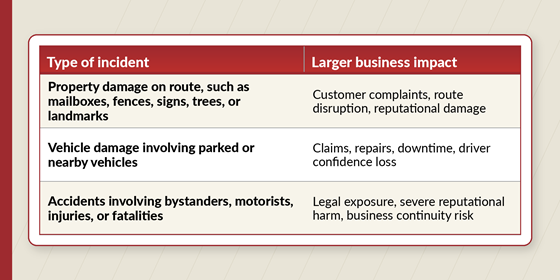
The point is not to operate from fear. The point is to operate with more control.
Every preventable incident you avoid helps keep your drivers and communities safer, your routes more predictable, and your business better protected.
Refuse Safety Starts With Understanding Refuse Risk
You do not need a safety study to understand that the risk is real. The data simply confirms what the route already makes clear.
A refuse truck is not an over-the-road truck with a different body. It faces a different kind of risk.
That is why safety cannot be treated as a generic feature added after the original build. It has to be designed into the truck from the beginning.
When the truck, body, and safety systems are considered together from the specification and design stage, the result is a cleaner, more purposeful tool, better suited for the task at hand. Drivers get support in the places where the job is hardest. Technicians work with integrated systems rather than layers of add-ons. Fleet owners get a truck designed around the actual risk profile of refuse operations.
That matters because the risk is not theoretical. Analysis of FMCSA data for all Class 7-8 refuse vehicles in the U.S. between 2023-2025 shows that, in that period, ~4.5% of all refuse vehicles were part of a reportable accident, including 3,059 crashes with injuries and 214 crashes that resulted in fatalities.
For a fleet operator, those numbers are not just a statistic - It is a reminder that even strong fleets with strong drivers benefit from every additional layer of prevention.
What Broader Safety Coverage Means for You
Autocar’s ADAM™ Safety Systems approach is built around the way refuse trucks operate. The practical value is that more of the truck’s risk zones are covered: front, side, passenger side, backing events, traffic sign awareness, pedestrians, and stability events.
That matters because a lower-cost system is not the same thing as a lower-risk system.
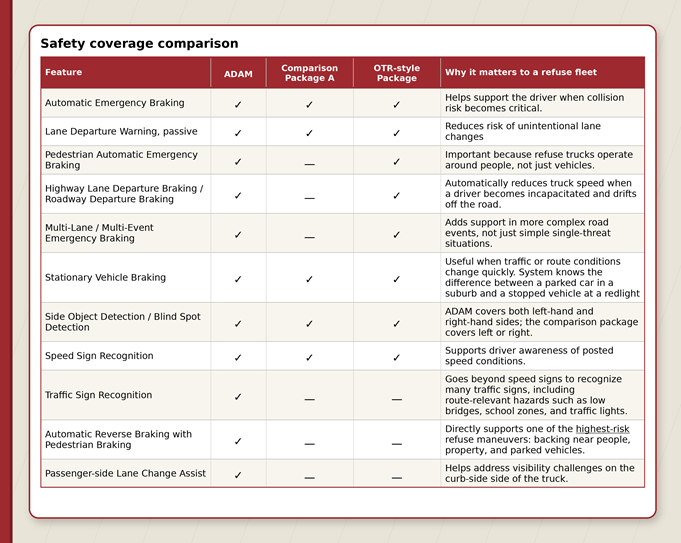
The takeaway is simple: other systems may share some features, but ADAM brings them together in one refuse-focused package designed into the truck from the beginning. For customers, that means safety is not a separate after-build system to manage later. It is part of the truck’s foundation.
That is not technology for technology’s sake. It is safety coverage shaped around the route.
The Right Coverage Matters
Not all safety packages are the same. For refuse fleets, the question is not whether a truck has a few familiar safety acronyms. The question is whether the system covers the situations refuse trucks face every day.
Autocar’s ADAM safety system is designed around that broader coverage. Based on the comparative chart above, ADAM is the only option shown with the full refuse-focused combination of both-side blind spot detection, automatic reverse braking with pedestrian braking, passenger-side lane change assist, and traffic sign recognition that goes beyond speed signs to include route-relevant conditions such as low bridges, school zones, and traffic lights.
That distinction matters because a refuse truck’s risk does not come from one direction.
Where broader coverage helps
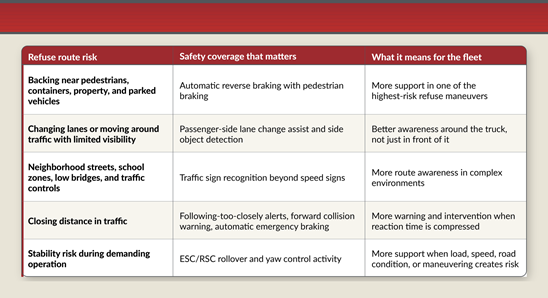
This is not about adding technology for technology’s sake. It is about matching safety coverage to the actual work.
Your Drivers Stay at the Center
Professional drivers are skilled, experienced, and responsible. Safety technology is not there to replace that judgment. It is there to support it.
Refuse drivers make hundreds of decisions every day. They manage mirrors, traffic, route conditions, pedestrians, parked vehicles, body operation, and timing. They work in environments where risk can appear suddenly and from more than one direction. Even the best driver benefits from systems that help identify danger early or step in when reaction time is compressed.
Some drivers may be cautious about systems that can intervene. That is understandable. Nobody wants technology that fights the driver or makes the job harder.
But most of us already drive personal vehicles with emergency braking, proximity alerts, blind spot detection, lane warnings, and other safety support. The question for refuse is practical: if these features make sense in a passenger vehicle, why would they matter less in a truck that can be twelve to fifteen times heavier?
The driver remains the most important safety system on the truck. ADAM is there to support that driver with added awareness and intervention when risk rises.
Communities Feel the Difference
A safer refuse truck is not just a fleet asset. It is part of the community.
Every route passes homes, schools, businesses, parks, and streets where people are living their normal day. A truck with better awareness around the vehicle, braking support in critical moments, and recognition of route hazards can help reduce the kinds of incidents that affect public trust.
That is especially important in refuse, because these trucks are visible. When they operate safely, consistently, and professionally, the community notices. When something goes wrong, the community notices even faster.
Safety protects people first. It also protects the relationship between the fleet operator and the community it serves, which can strengthen its reputation and help position it to win future business.
Technicians Benefit from Integrated Safety, Too
Fleet safety cannot create a maintenance burden that keeps trucks off the road. Uptime matters. Technician time matters. Simplicity matters.
That is why the way safety is integrated into the truck is important.
Autocar has produced more than 2,500 trucks equipped with ADAS. There is an erroneous perception that incorporating additional components related to ADAS could result in additional downtime. However, for Autocar units with factory-installed ADAS, customer feedback shows that the ADAS-related downtime is primarily driven by issues with the base ABS system, especially ABS wheel speed sensors. Those are systems that must be maintained for DOT compliance whether ADAS is on the truck or not.
Maintaining the foundational braking and ABS systems in good condition ensures no additional downtime is incurred and aids the safety systems to better perform their job.
The right safety system should help protect the route without complicating the shop.
The Numbers Show Why “It Hasn’t Happened to Us” Is Not a Safety Plan
A strong safety record is something to be proud of. It reflects good people, good training, and good management.
But the next route is not protected by yesterday’s record alone.
As previously cited, FMCSA data shows that there are over 180,000 Class 7–8 refuse vehicles in operation across the U.S. (inclusive of refuse roll-offs), with about 15 significant accidents per 1,000 vehicles annually. In other words, most trucks complete their work without incident, but the risk is real enough that every fleet must plan for it.
As of today, ADAS systems are equipped on more than 1,800 Autocar vehicles. On average, each of these vehicles saw ~93 system warnings and interventions in the last 12 months (one every ~2.5 working days). Most of these were related to forward vehicle proximity warnings or Rollover ROP engine control activation. That is 93 times per truck annually where the system helped drivers and fleet owners protect against more significant events.
The system also actively prevented 13 incidents from automatic emergency braking activation.
Refuse work gives safety systems many opportunities to help. The value is not only in rare emergencies. It is in the repeated moments where awareness, warning, stability support, and braking support can help reduce risk.
For a fleet owner, a strong safety record is not a reason to stand still. It is something worth protecting even more.
The question a diligent fleet owner should be asking is, ‘What can we do to further reduce the chance that the next serious incident happens in our fleet?”
The Investment Case Is Also a Safety Case
Safety decisions are human decisions first. They are also business decisions.
A refuse truck may stay in operation for around a decade. Spread across that life, the added cost of an advanced safety system like ADAM can be less than $1,000 per year of operation. Compare that with the cost of even a minor incident, before downtime, repair time, insurance administration, customer calls, driver disruption, and reputational impact are considered.
That is why safety should not be viewed only as an equipment cost. It is a risk-management investment.
That is what makes safety bigger than a feature package.
A Safer Truck Is a Smarter Business Decision
The best safety philosophy is not built around fear. It is built around responsibility.
Responsible fleets want to protect their drivers. They want to protect and serve communities well. They want technicians working on trucks that make sense. They want fewer preventable incidents, fewer unexpected costs, and fewer days spent reacting to problems that could have been avoided.
That is the larger impact of safety.
A refuse truck built around safety is not simply a safer truck. It is a better business tool. It supports the people doing the work. It protects the people around the work. And it helps you protect the investment you depend on every day.
For a fleet that wants to operate with confidence, that makes the choice clear: safety is not an afterthought. It is the foundation.
Learn more about the Autocar ADAM safety system:
-------------------------------------------
Refuse vehicles were defined as all Class 7 and 8 vehicles whose registering company have a NAICS Code starting with 562; it excludes those with a registration vocation given as Bus Transportation, Petroleum, Emergency Vehicles, Beverage Processing & Distribution, Food Processing & Distribution, General Freight, Construction, Utility Services, Manufacturing, or those whose NAICS Description is either Fire Protection or Police Protection. For Cabover vehicles, it includes vehicles with the following OEMs: Battle Motors, Crane Carrier, Dennis Eagle, Freightliner, Kenworth, Peterbilt, Autocar LLC, Lodal, Mack, Sterling Truck, and Volvo. It excludes all Tractor trucks.