
- No results found
-
{{page.data.Name}}

The Truth About 2027 Truck Emissions and Engine Changes for Fleets
The noise is real
A lot of the misinformation in the market is coming from the fact that several different stories are getting mashed together. The federal heavy-duty low-NOx rule adopted in 2022 is still on the books for model year 2027. At the same time, EPA has made other high-profile announcements that are easy to confuse with that rule, including guidance on DEF-sensor requirements. Add in the fact that public OEM websites often lag supplier roadmaps, and it is no surprise fleets feel like they are hearing two different versions of the future.
That distinction matters. A supplier roadmap is not the same thing as a chassis-specific order guide, and a chassis-specific public web page is not the same thing as current dealer allocation or final production planning. In practice, supplier announcements, OEM integration timing, and actual build-slot availability can all move on different clocks. That is why fleets should treat any “this engine is staying” or “this engine is going” conversation as two separate questions: what the regulations require, and what a specific OEM can still build and deliver in a specific window.
The rule is still coming
At the federal level, the facts are straightforward. The EPA’s heavy-duty engine and vehicle standards for model year 2027 and beyond introduce stricter fuel consumption requirements compared to today’s rules. In parallel, the EPA is reviewing engine warranty requirements, with updates expected as early as this quarter.
California is part of the story too, not because 2027 is “only a California problem,” but because California has already exposed how disruptive the transition can be. CARB’s Heavy-Duty Omnibus regulation tightened standards beginning in 2024, then CARB amended the program in 2023 after manufacturers signaled product-availability issues for 2024 through 2026. CARB now says the Clean Truck Partnership committed staff to propose 2027-and-later amendments that would mostly align California’s heavy-duty engine standards and test procedures with EPA’s Clean Trucks Plan NOx rule. In plain English, the supply and specification disruption many fleets think of as a future event has already shown up in the market, and regulators have already had to respond to it.
The engine roadmap is shifting
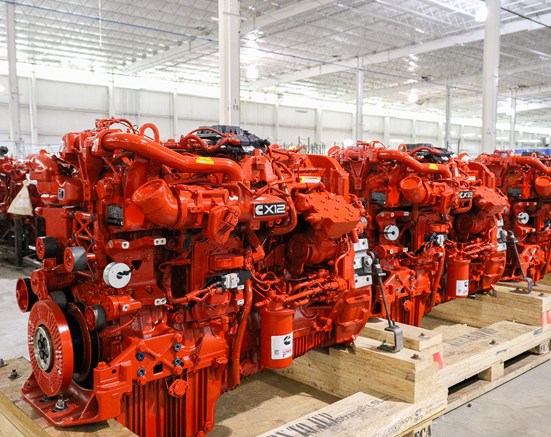
The biggest indicator in the market is Cummins’ own public roadmap. This plan shows that the X10 is designed to replace both the L9 and X12 platforms, will be available in 2027, and is targeted squarely at vocational, refuse, dump, mixer, pickup-and-delivery, transit, and other demanding applications. It is rated at up to 450 horsepower and 1,650 lb-ft of torque on the heavy-duty side and is explicitly positioned as a consolidation move, not a small refresh. For fleets that have historically bought around a familiar 9-liter-versus-12-liter decision tree, that is a major shift in how the menu will look.
And the engineering response to 2027 is not limited to calibration. Cummins says its 2027 X15 and X10 platforms use a larger twin-module aftertreatment system with electric heating and a dedicated 48-volt architecture for emissions. They also say the 2027 X15 can deliver up to 4% better fuel efficiency while keeping the overall engine-and-aftertreatment system weight neutral versus the prior X15 package. In other words, OEMs are not simply polishing current hardware; they are making visible architecture changes in combustion, aftertreatment, thermal management, and electronics.
Not every alternative is disappearing, but the mix is changing. Public sources show that the CNG (Compressed Natural Gas) L9N remains a near-zero natural-gas option with simpler three-way-catalyst aftertreatment. Cummins has also introduced the B6.7 Octane gasoline engine as a 2027-compliant medium-duty option that eliminates DEF and active regens. So yes, fleets will still have choices. But those choices are increasingly coming down to a new 10-liter platform, a redesigned 15-liter diesel, carryover natural-gas engines, or newer gasoline options—not the familiar L9/X12/older 12-liter natural-gas mix that many buyers have built their habits around.
The online conversation tells a useful story
If you read across the industry, four camps emerge.
The fleet strategy that makes sense now
For severe-duty fleets, this isn’t just an engine change—it’s a system change. New platforms mean tighter packaging, more sensors, and more heat. Integration becomes critical, because these emissions systems are now central to how the truck operates. Any deviation—cutting into harnesses, relocating components, or working around the design—introduces unnecessary risk to reliability, safety, and uptime.
That is why the smartest fleet response is not “pre-buy everything,” and it is not “wait for perfect clarity.” It is a spec-by-spec plan. Lock in proven 2026 builds where packaging, body integration, technician familiarity, or residual-risk control matter most. Intentionally pilot next-generation platforms where the duty cycle can tolerate learning and where the new technology offers a clear upside. Finally, do not assume the order board will remain wide open while the market debates. Multiple fleet-facing sources now warn that production capacity is finite, order boards can tighten, and fleets that move earlier keep more control over pricing, timing, and configuration.
There is also an opportunity hidden inside the disruption. The fleets that handle this well will not just “beat a regulation”; they will sharpen their spec discipline. Some applications will still justify locking down a known diesel drivetrain before the transition. Others may be better served by moving to the X10. Some operations with return-to-base fueling or strong fuel-cost visibility may have a compelling case for L9N, X15N, or B6.7 Octane, especially where DEF-free operation, regeneration simplicity, or fuel-price stability matter. The right answer depends on route density, payload sensitivity, body integration, refueling reality, and maintenance capability—but the fleets that start now will get to choose their transition instead of being forced into one.
The bottom line
The honest message for fleets is simple: 2027 is not the end of diesel, but it is the end of easy assumptions. The rules are real. The platforms are changing. The online noise is often rooted in real developments, but many of those developments are being misread. A DEF-sensor guidance change is not a repeal of the model year 2027 engine rule. A lobbying campaign for delay is not the same thing as a finalized delay. What the public record shows today is a market moving toward cleaner but more complex trucks, narrower availability for some legacy engine families, newer platform choices, and a procurement window that rewards planning.
For fleets, that means the question is no longer, “Will 2027 happen?” The real question is, “Which risk do we want to own?” Do you want the known drivetrain, known packaging, and known cost structure you can still secure before the transition tightens? Or do you want to be among the first to absorb new-platform learning curves, new service practices, and whatever pricing lands once the 2027 market fully settles? The thought-leadership answer is not fear, it is preparedness. The practical answer is to identify the applications that cannot afford disruption, secure those builds early, and transition the rest deliberately.